Everything You Need to Know About Diamond Buying
Why Diamond Buying Feels Overwhelming (And How to Make It Simple)
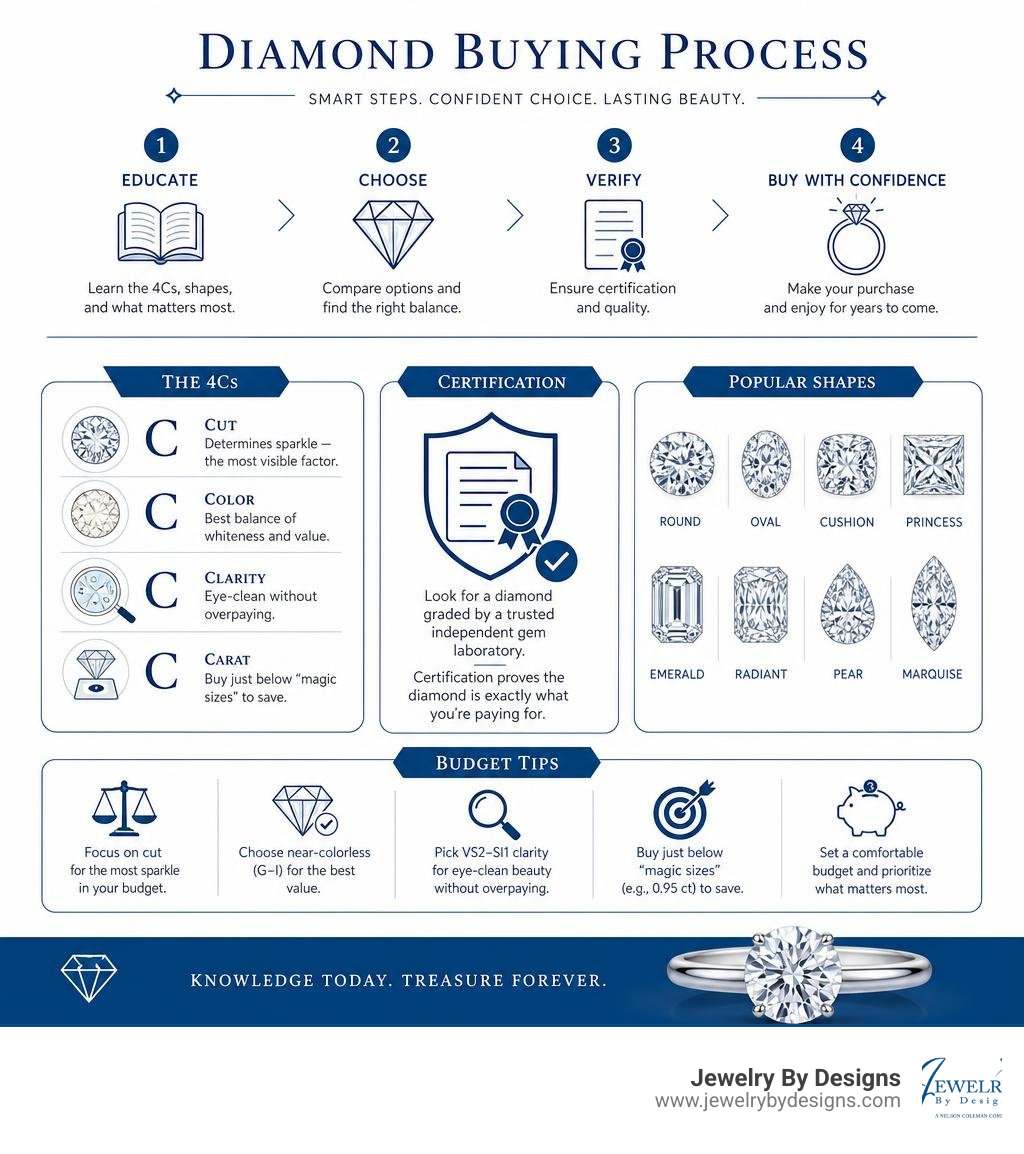
Diamond buying is one of the most meaningful purchases you’ll ever make — and one of the most confusing. Here’s a quick overview of what matters most:
Quick Guide: Diamond Buying Essentials
| What to Focus On | Why It Matters |
|---|---|
| Cut quality | Determines sparkle — the most visible factor |
| Color grade (G–I) | Best balance of whiteness and value |
| Clarity grade (VS2–SI1) | Eye-clean without overpaying |
| Carat weight | Buy just below “magic sizes” (e.g., 0.95 ct) to save |
| Certification (GIA/IGI) | Proves the diamond is exactly what you’re paying for |
| Natural vs. lab-grown | Lab-grown costs ~30% less with identical beauty |
There are thousands of diamonds to choose from. Online retailers often show hundreds of thousands of options. That’s a lot of choices for what should feel like a joyful moment.
Most people walk in knowing almost nothing — and walk out either delighted or quietly unsure they made the right call. The difference usually comes down to one thing: having the right information before you shop.
As GIA puts it: “Every diamond is as unique as the person who wears it. Regardless of which diamond you choose, every purchase should start with accurate information.”
At Jewelry By Designs, we’re one of the largest jewelry stores in Prince William County, and our certified, knowledgeable staff has guided Northern Virginia families through the diamond buying process for years. We’re here to make sure you feel confident every step of the way.
The Core of Diamond Buying: Understanding the 4Cs
When you begin your diamond buying journey, the very first thing you will encounter is “the 4Cs.” Coined by Robert M. Shipley, the founder of the Gemological Institute of America (GIA), this universal grading system completely revolutionized how the world evaluates diamonds.
Before the 4Cs, there was no standardized language to describe diamond quality. Today, it is the absolute foundation of how we assess a diamond’s beauty and market value. You can read our detailed breakdown of The 4 Cs of Diamonds to see how they interact, or explore GIA’s official guide on How to Buy a Diamond | GIA 4Cs for a deeper scientific look.
To keep it simple, here is what the 4Cs stand for:
- Cut: This refers to how well a diamond’s facets interact with light. It is not the shape of the diamond (like round or pear), but rather the craftsmanship, symmetry, and proportions of the stone.
- Color: The GIA color scale ranges from D (completely colorless) to Z (light yellow or brown). Truly colorless diamonds are incredibly rare and command the highest prices.
- Clarity: This measures the purity of the diamond. Internal characteristics are called “inclusions,” while surface flaws are called “blemishes.” The scale ranges from Flawless (FL) to Included (I3).
- Carat Weight: This is the physical weight of the diamond, not its physical dimensions. One carat is equal to exactly 200 milligrams (about the weight of a paperclip).

How Diamond Cut Affects Sparkle and Value
If there is one “C” you should never compromise on, it is the cut. You can buy a diamond with perfect color and flawless clarity, but if it is poorly cut, it will look dull, glass-like, and flat. Conversely, a masterfully cut diamond with slightly lower color and clarity can look absolutely breathtaking because of how it dances in the light.
When we talk about a diamond’s sparkle, we are actually looking at three distinct optical effects:
- Brilliance: The total amount of white light reflected back to your eye from the inside and surface of the stone. To understand this better, take a look at our guide on What is Diamond Brilliance?.
- Fire: The scattering of light into a spectrum of vivid rainbow colors.
- Scintillation: The flashes of light and dark (the sparkle) that occur when the diamond, the light source, or the observer moves.
Only standard round brilliant diamonds receive an official GIA cut grade ranging from Excellent to Poor. For fancy shapes (like ovals, cushions, or emerald cuts), grading is more subjective, making it vital to work with an experienced in-house gemologist who can evaluate the stone’s actual light performance in person.
Navigating Diamond Fluorescence in Your Diamond Buying Journey
As you compare grading reports, you might notice a section labeled “Fluorescence.” This is a natural phenomenon where a diamond emits a soft glow when exposed to ultraviolet (UV) light, such as natural sunlight or blacklights.
According to GIA statistics, approximately 25% to 35% of natural diamonds submitted to their laboratory exhibit some degree of fluorescence. In more than 95% of these cases, the fluorescent color is blue.
But does fluorescence actually damage the look of your diamond?
- The Reality: Only 10% of fluorescent diamonds show enough fluorescence to impact their visual appearance in normal lighting.
- The Haze Factor: Fewer than 0.2% of fluorescent diamonds exhibit a hazy, milky, or oily appearance due to nano-inclusions.
- The Value Play: In diamonds with lower color grades (such as I, J, or K), a medium blue fluorescence can actually make the diamond look slightly whiter and brighter by counteracting the faint yellow tint. Best of all, fluorescent diamonds often sell at a 2% to 15% discount, making them a fantastic “sweet spot” for budget-conscious buyers.
Choosing Your Diamond Shape and Style
Selecting the right shape is where the emotional side of diamond buying truly shines. While “cut” refers to the quality of the faceting, “shape” refers to the physical outline of the stone.

The round brilliant remains the most popular and classic shape, largely because its 58 facets are mathematically optimized to deliver maximum sparkle. However, “fancy shapes” (any shape other than round) offer incredible character and often cost up to 25% less than a round diamond of identical carat weight.
Brilliant Cuts vs. Step Cuts
When exploring fancy shapes, you will generally choose between two distinct faceting styles:
- Brilliant Cuts: These include shapes like the oval, princess, cushion, radiant, pear, and marquise. Their triangular and kite-shaped facets are designed to maximize sparkle, fire, and scintillation. They are excellent at hiding tiny inclusions and slight body color.
- Step Cuts: These include the elegant emerald and Asscher cuts. Instead of sparkling like a disco ball, they feature long, parallel facets that create a “hall-of-mirrors” effect. They prioritize transparency and sleek, architectural lines. Because step cuts are so open, they require higher clarity grades (usually VS2 or higher) to ensure no inclusions are visible.
Another beautiful step cut option is the baguette, often used as accent stones in custom designs. If you are curious about these geometric beauties, check out our article on What is a Baguette Diamond?.
Selecting the Perfect Setting for Your Diamond Buying Budget
Once you have selected your stone, you need to find its home. The setting holds your diamond secure while expressing the wearer’s personal style.
Common setting styles include:
- Solitaire: A timeless single-stone setting that keeps all the attention on your center diamond.
- Halo: A ring of smaller accent diamonds surrounding the center stone. This can make your center diamond look up to half a carat larger than it actually is!
- Three-Stone: Representing the past, present, and future of your relationship.
Your choice of metal also plays a critical role in your budget. If you choose a warm metal like yellow or rose gold, you can safely drop to a lower color grade (like I or J) because the metal’s warmth naturally masks any faint yellow tint in the diamond. If you prefer platinum or white gold, you’ll want to stick to a colorless or near-colorless diamond (D through H) so the stone looks crisp and bright. For a complete walk-through of ring design, read our comprehensive Engagement Ring Buying Guide.
Natural vs. Lab-Grown Diamonds
One of the most important decisions modern buyers face is choosing between earth-mined (natural) and lab-grown diamonds.
To be absolutely clear: lab-grown diamonds are real diamonds. They are not cubic zirconia or moissanite. They share the exact same chemical, physical, and optical properties as natural diamonds. They are composed of pure carbon and are graded on the exact same 4Cs scales. Even a highly experienced gemologist cannot tell them apart without highly specialized laboratory testing equipment.
Lab-grown diamonds are created using one of two advanced scientific methods:
- Chemical Vapor Deposition (CVD): A tiny diamond seed is placed in a vacuum chamber filled with carbon-rich gas, which is heated until carbon atoms rain down and crystallize on the seed.
- High Pressure High Temperature (HPHT): This process mimics the extreme heat and crushing pressure of the Earth’s mantle to grow a diamond from carbon.
Here is a direct comparison to help you choose:
| Feature | Natural Diamonds | Lab-Grown Diamonds |
|---|---|---|
| Origin | Formed deep in the Earth over billions of years | Created in a controlled laboratory over weeks |
| Price | Premium pricing reflecting rarity | Significantly more affordable (often 30% to 70% less) |
| Resale Value | Retains a solid percentage of its value over time | Minimal resale value due to unlimited production capacity |
| Rarity | Finite resource; highly collectible | Scalable; easily produced on demand |
| Best For | Traditionalists, heirloom buyers, and investment value | Maximizing size and quality on a modest budget |
For more options, you can read the GIA’s guide to Natural Diamonds | Diamond Stone – GIA C to understand the enduring appeal of earth-mined gems.
Verification, Certification, and Smart Shopping
The old saying goes: “If you don’t know your jewelry, know your jeweler.” Because diamonds are highly technical, you must rely on unbiased, third-party grading reports to verify what you are buying.
Always insist on a grading report from a reputable, independent laboratory like the Gemological Institute of America (GIA) or the International Gemological Institute (IGI). These reports act as the diamond’s “passport,” detailing its exact measurements, proportions, and 4Cs grades.
Reputable diamonds also feature a microscopic laser inscription on the girdle (the outer edge of the stone) that matches the number on the grading report. Always ask your jeweler to show you this inscription under a microscope or jeweler’s loupe before purchasing.
Diamond Red Flags to Avoid
- “One-Day-Only” Sales: High-pressure retail tactics designed to stop you from comparing prices.
- Uncertified Stones: Avoid buying any diamond over 0.50 carats that does not have an independent GIA or IGI report.
- In-House Certifications: If the store graded the diamond themselves, there is a strong conflict of interest.
- Too-Good-To-Be-True Prices: If an online stone is priced thousands below market value, it likely has hidden structural issues like extreme cloudiness or a brown undertone that doesn’t show up on the paper certificate.
How to Verify a Diamond is Real
While the classic “fog test” (breathing on a stone to see how quickly the condensation clears) can weed out cheap glass, it is not foolproof. Synthetic stones like moissanite can easily trick basic thermal testers.
The only way to be 100% certain of a diamond’s authenticity is to have it evaluated by a certified professional. Learn more in our guide on How to Know if a Diamond Ring is Real.
Loose Diamonds vs. Finished Jewelry
When you buy a pre-set diamond ring, you are buying a finished product. While convenient, it can sometimes hide imperfections under the prongs.
Buying a loose diamond allows you to inspect the stone from every single angle under magnification before it is set. It also gives you total freedom to design a completely custom setting. If you want to explore this exciting route, we invite you to Discover Stunning Loose Diamonds right here in our Woodbridge showroom.
Frequently Asked Questions About Diamond Buying
How do I set a realistic budget for a diamond?
Forget the outdated “two to three months’ salary” rule. That was a marketing campaign created decades ago! Your budget should be based entirely on your personal financial situation and comfort level.
To maximize your budget, use the “buy-shy” strategy. Diamond prices jump exponentially at “magic numbers” like 1.00, 1.50, and 2.00 carats. By purchasing a diamond that weighs 0.95 or 1.90 carats, you can save up to 20% while getting a stone that looks visually identical to a full-carat stone.
How do I care for and clean my diamond after purchase?
Diamonds are the hardest natural substance on earth, but they can still chip if struck at the right angle, and they easily attract grease and lotion.
To clean your diamond at home:
- Soak your ring in warm water mixed with a few drops of mild dish soap (like blue Dawn) for 20 to 30 minutes.
- Gently scrub the stone with a soft-bristled toothbrush, paying special attention to the back of the diamond where dirt collects.
- Rinse thoroughly under warm running water (make sure the drain is closed!) and dry with a lint-free cloth.
We also highly recommend bringing your jewelry into our Woodbridge store twice a year for a complimentary professional ultrasonic cleaning and prong inspection to make sure your stone remains completely secure.
What is the Kimberley Process and why does it matter?
Established in 2003, the Kimberley Process is an international certification scheme designed to prevent “conflict diamonds” (blood diamonds) from entering the mainstream rough diamond market. Today, over 99% of the global diamond supply is certified conflict-free through this rigorous supply-chain monitoring system. We are proud to source only ethically mined, Kimberley Process-compliant natural diamonds.
Conclusion
At the end of the day, diamond buying shouldn’t feel like a high-stakes math test. It is a celebration of love, commitment, and milestone moments.
While online spreadsheets can help you compare numbers, they cannot show you how a diamond actually comes to life when the light hits it. That is why working with a trusted, local jeweler makes all the difference.
At Jewelry By Designs, we have served the Woodbridge and greater Northern Virginia communities with pride, offering nearly 200 years of combined family jewelry expertise. Our in-house, GIA-trained jewelers are here to help you cut through the confusion, answer your questions honestly, and find a stone that truly speaks to you.
Ready to find your perfect stone? Use our online Diamond Search tool to browse our live inventory, or Explore Loose Lab-Grown Round Brilliant Diamonds to see how you can get incredible size and sparkle within your budget. Better yet, stop by our Woodbridge, VA showroom today to see these beautiful gems in person!