What are Lab-Grown Diamonds?
Lab-grown diamonds are diamonds that are grown in a laboratory process instead of being mined from the earth. There are two processes used to create diamonds: High-Temperature High-Pressure (HTHP) and Chemical Vapor Deposition (CVD). They are structurally identical to mined diamonds and are able to be appraised. The main differences are age, origin, and price.
They can be referred to by many names, such as “lab-grown”, “lab-created,” “manmade,” “lab, “artificial,” “synthetic,” and “cultivated.” You will typically see non-lab diamonds referred to as “mined” or “natural” diamonds.
It’s important to note that the phrase “diamond simulant” does not refer to lab-created diamonds or a stone with the same chemical composition as a diamond. If you’re not familiar with the source you’re purchasing from, don’t be afraid to ask for clarification if you have any suspicions about what they are advertising.
Are Lab-Grown Diamonds Real?
As the market becomes increasingly saturated with lab-grown diamond jewelry, there are many questions about the authenticity of lab-grown diamonds compared to mined or natural diamonds. The good news is that they are structurally identical in every way. The main ways that they differ are in origin, age, and retail value.
Lab Grown vs. Natural Diamonds
The main difference between lab-grown diamonds and mined diamonds is the price. Lab-grown diamonds typically cost 20-30% less than mined diamonds. But because they are identical in every other way, lab-grown diamonds are a great choice for anyone looking for a beautiful, high-quality diamond on a budget.
QUALITY | MINED DIAMOND | HPHT LAB DIAMOND | CVD LAB DIAMOND |
HARDNESS (MOHS) | 10 | 10 | 10 |
TOUGHNESS | Very Good | Very Good | Very Good |
REFRACTIVE INDEX | 2.417 | 2.417 | 2.417 |
ORIGIN | Earth’s mantle | Laboratory | Laboratory |
METHOD | Extreme pressure and heat, over 2000 degrees Fahrenheit and around 727,000 pounds per square inch of pressure | Uses high pressure and high temperature to replicate the natural conditions in which diamonds are made at about 2700 degree Fahrenheit and 1.5 million pounds per square inch of pressure | Uses a hydrocarbon gas mixture subjected to medium temperatures and pressures in a vacuum chamber. |
AGE | One to three billion years old | About 3-7 days for a 1-carat diamond | About 7-14 days for a 1-carat diamond, plus HPHT refining is often done |
PROS | Traditional and romantic. Familiar and comfortable for many modern consumers. | Fastest way to create lab diamonds | This method is now known for creating higher-quality diamonds |
CONS | Rare to find jewelry-quality diamonds. | Lower average clarity than CVD. Can show a bluish tint from nitrogen | Larger diamonds may require multiple growth steps. Diamonds can have a brownish color and may require HPHT for color optimization |
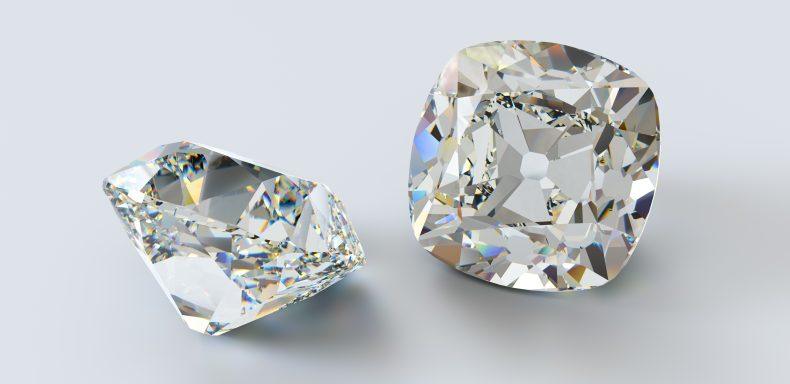
While there are some key differences between mined and lab-created diamonds, lab-grown diamonds are structurally and compositionally the exact same as a mined diamond.
How are Lab-Created Diamonds Grown?
Lab-grown diamonds can be created using one of two processes: high-pressure, high-temperature (HPHT) and Chemical Vapor Deposition (CVD). The raw form of mined diamonds, HPHT diamonds, and CVD diamonds all look different from one another, as you can see in the images below.
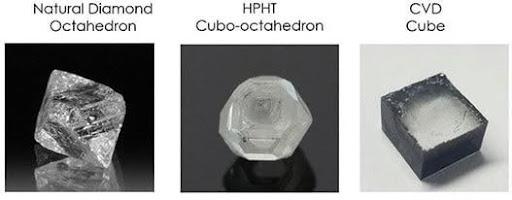
However, each of these diamonds has the same hardness, toughness, refractive index, look, feel, and sparkle. The four Cs: cut, carat, clarity, and color, can all be applied to any of these diamond types. The major differences are age, origin, and retail cost.
HPHT
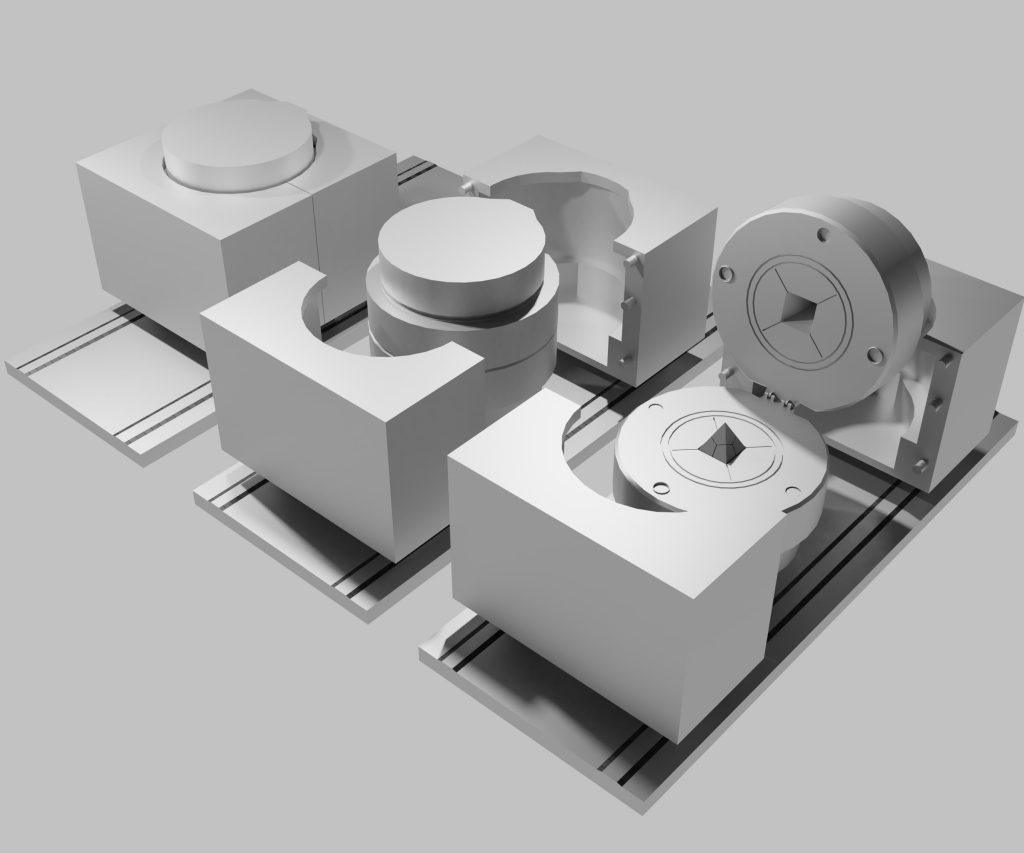
The HPHT (high-pressure, high-heat) process attempts to mimic the pressure and heat that naturally form diamond crystals. In this process, a pure carbon powder (such as graphite) is pressed into a growth capsule and placed in a growth chamber. Extreme heat (up to 2000 degrees F) and high pressure (870,000+ pounds per inch) are applied, and a diamond crystal begins to form atom by atom. HPHT diamond crystals form a cubo-octahedron crystal rather than the octahedron crystal of a natural diamond. This gives them dramatically different internal growth patterns than mined diamonds. Through this process, large diamonds, up to 10 carat rough crystals, can be formed in under two weeks.
CVD
The other common process is CVD (Chemical Vapor Deposition). CVD works similarly to 3D printing, where the diamond is grown layer by layer. This process begins with a diamond wafer placed in a vacuum chamber. The inside of the chamber is heated to 2192 degrees F by either a microwave or a laser, which vaporizes the plasma cloud of carbon-rich gases (hydrogen and methane). The carbon atoms rain down on the diamond wafer, forming a uniform coating of diamond. This process takes longer than HPHT to grow a diamond crystal that can be cut and polished into a 1 carat loose diamond. It also typically requires additional HPHT treatment to optimize the color. The CVD process forms a diamond crystal with cubic and vertical growth.