Don’t Get Fleeced: Finding the Best Place to Sell Scrap Gold
Don’t Get Fleeced: What’s the Best Place to Sell Scrap Gold?
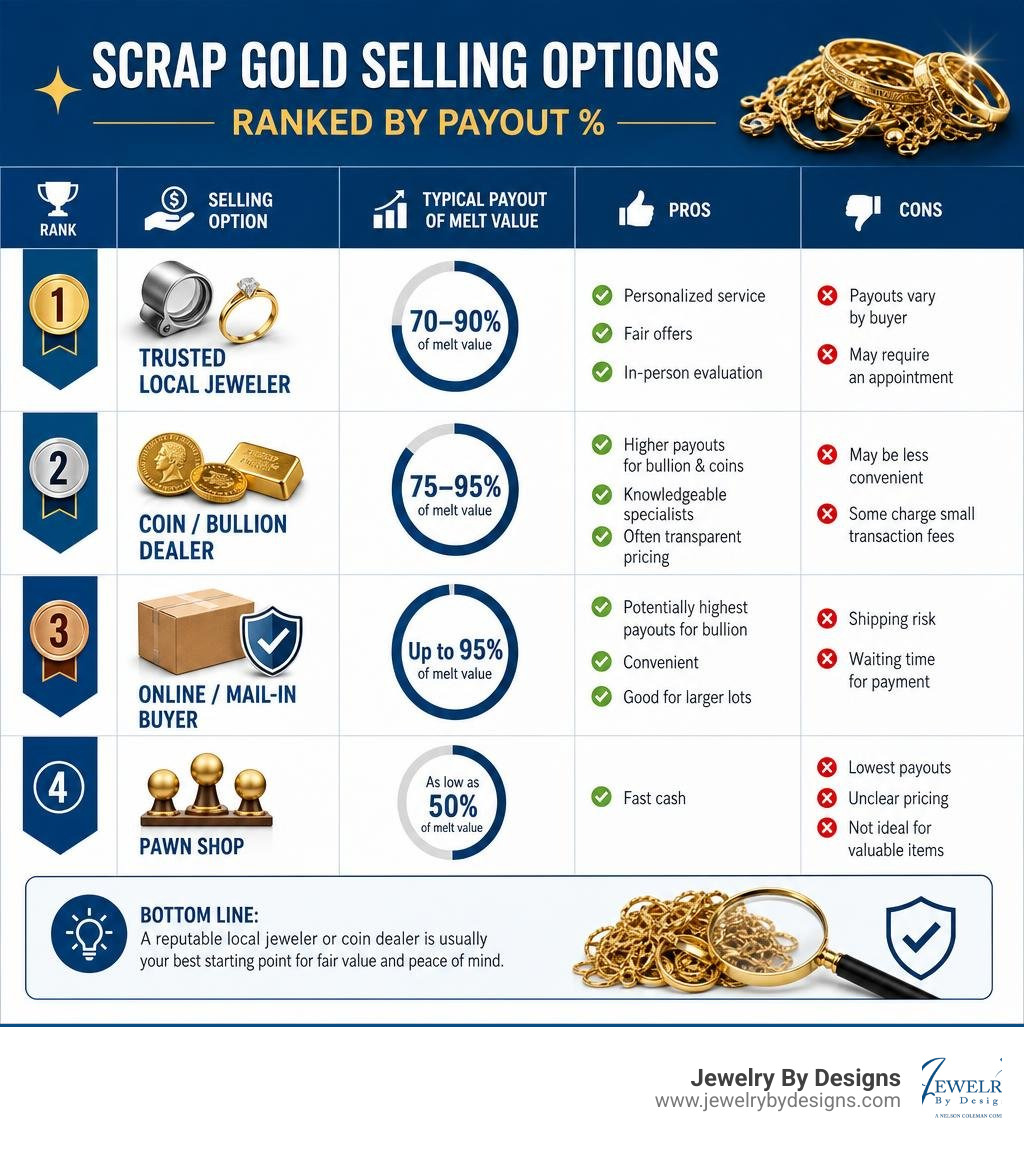
Finding the best place to sell scrap gold comes down to three things: transparency, fair pricing, and a buyer you can trust. Here’s a quick breakdown of your main options:
| Buyer Type | Typical Payout | Best For |
|---|---|---|
| Trusted local jeweler | 70–90% of melt value | Personalized service, fair offers |
| Coin/bullion dealer | 75–95% of melt value | Gold coins, bullion |
| Online/mail-in buyer | Up to 95% for bullion | Convenience, larger lots |
| Pawn shop | As low as 50% of melt value | Speed only |
Bottom line: A reputable local jeweler or coin dealer is usually your best starting point — especially if you want a transparent, in-person evaluation with no shipping risk.
Gold prices hit record highs above $5,000 per ounce in early 2026. That’s great news if you have old chains, broken rings, mismatched earrings, or dental crowns sitting in a drawer. But high prices also attract buyers who count on sellers not knowing what their gold is worth.
The result? A lot of people walk away with far less than they should.
This guide cuts through the confusion. You’ll learn exactly how scrap gold is priced, where to sell it, and what questions to ask so you don’t leave money on the table.
At Jewelry By Designs, we’re one of the largest jewelry stores in Prince William County, with certified staff who provide knowledgeable appraisals and honest evaluations — making us a trusted local answer to the question of the best place to sell scrap gold in Northern Virginia. Whether you have a single broken necklace or a full collection to liquidate, we’re here to help you understand exactly what you have and what it’s worth.
What is Scrap Gold and How is it Valued?
Before you step into a shop or request a mail-in kit, it helps to understand what “scrap gold” actually means. Many people assume scrap gold is just industrial waste or gold teeth. In reality, scrap gold is any item containing gold that is no longer wanted or usable in its current form.
This includes:
- Broken jewelry, worn-out chains, and single, mismatched earrings
- Old class rings or wedding bands from past relationships
- Gold dental crowns, bridges, and inlays
- Damaged gold coins or bent bullion bars
- Gold-filled items, sterling silver flatware, or vintage watches
When you sell these items to a scrap buyer, they aren’t looking at the brand name, the designer craftsmanship, or the emotional history. They are looking at the raw metal content. The ultimate destination for scrap gold is a refinery, where it will be melted down, purified, and recycled into brand-new jewelry or bullion. Because the item is going to be melted, its value is determined entirely by two key metrics: its karat purity and its weight.

Understanding Karat Purity and Weight
Pure gold is incredibly soft—too soft to hold up to the daily wear and tear of a ring or a necklace. To make it durable, manufacturers alloy pure gold with other metals like copper, silver, nickel, or zinc. The ratio of pure gold to these alloy metals is measured in karats (K):
- 24 Karat (24K): 99.9% pure gold. This is the standard for investment-grade bullion bars and certain high-end coins.
- 18 Karat (18K): 75% pure gold. Often found in high-end luxury jewelry.
- 14 Karat (14K): 58.3% pure gold. This is the most common purity level for jewelry in the United States.
- 10 Karat (10K): 41.7% pure gold. This is the legal minimum to be called “gold” in the U.S. and is highly durable.
To find your item’s purity, look closely for a tiny stamp (called a hallmark). You might see “14K,” “18K,” or decimal numbers like “585” (representing 58.5% purity for 14K) or “750” (representing 75% purity for 18K). If your item is vintage, worn, or lacks a stamp entirely, a professional jeweler can perform a safe test to determine the exact karat.
Once the purity is established, the gold must be weighed. In the precious metals industry, weight is typically measured in grams or pennyweights (dwt), rather than standard ounces.
- Note: One pennyweight (1 dwt) is equal to approximately 1.555 grams.
- Gold spot prices are quoted in troy ounces, which are different from standard kitchen ounces. A troy ounce equals 31.103 grams, whereas a standard ounce is only 28.35 grams. Always clarify which unit of weight a buyer is using so you can compare offers accurately!
How Market Spot Prices Determine Melt Value
The “spot price” is the current market price at which one troy ounce of pure (24K) gold is actively trading. Because gold is a globally traded commodity, this price fluctuates constantly throughout the business day.
To determine the “melt value” of your scrap gold, a buyer uses a straightforward mathematical formula:
$$text{Melt Value} = text{Weight of Pure Gold} times text{Current Spot Price}$$
For example, if you have a 14K gold necklace that weighs 20 grams, the calculation works like this:
- Determine Purity: 14K gold is 58.3% pure gold.
- Calculate Pure Gold Weight: $20 text{ grams} times 0.583 = 11.66 text{ grams}$ of pure gold.
- Convert to Troy Ounces: $11.66 text{ grams} div 31.103 text{ grams per troy ounce} = 0.375 text{ troy ounces}$ of pure gold.
- Calculate Melt Value: If the gold spot price is at $5,000 per troy ounce, your necklace has a raw melt value of $0.375 times $5,000 = $1,875$.
However, it is crucial to understand that no buyer will pay you 100% of the melt value. Buyers have overhead costs, rent, utilities, and employee salaries to pay. They also must cover the refining costs to melt and purify the metal, and they need to make a reasonable profit margin. A fair and highly competitive offer for scrap jewelry typically ranges between 70% and 90% of the actual melt value, while pure gold bullion coins might fetch up to 95% or 98% from top-tier dealers.
Evaluating the Best Place to Sell Scrap Gold
When you decide to sell, you will quickly realize there is no shortage of people willing to take your gold. However, the experience, security, and payout you receive will vary wildly depending on which route you choose.
| Buyer Category | Pros | Cons |
|---|---|---|
| Trusted Local Jewelers | Immediate cash/check, face-to-face transparency, high payout rates, expert GIA staff on-site. | Must visit during business hours. |
| Coin & Bullion Dealers | Excellent for pure coins and bars, transparent pricing linked to live spot markets. | Less interested in scrap jewelry or dental gold; may offer lower rates for non-bullion items. |
| Online & Mail-In Buyers | Convenient, great for rural areas, can offer competitive rates due to low overhead. | Shipping risks, waiting period for payment, potential for hidden fees, difficult to haggle. |
| Pawn Shops | Instant cash, open long hours. | Typically offer the lowest payouts (often 50% to 60% of melt value), unspecialized staff. |
Why a Trusted Local Jeweler Beats Quick-Cash Outlets
For most sellers, a trusted local jeweler represents the best place to sell scrap gold. Unlike unspecialized buyers—such as pawn shops, pop-up “hotel buying events,” or roadside cash-for-gold booths—a reputable jeweler employs staff trained by organizations like the Gemological Institute of America (GIA).
At Jewelry By Designs in Woodbridge, VA, we evaluate your items right in front of you. We don’t just see “scrap metal.” If your broken jewelry contains diamonds or valuable gemstones, we can evaluate those stones as part of the offer, whereas a generic scrap buyer will often tell you they “don’t pay for stones” and simply deduct their weight from the gold payout.
Furthermore, local jewelers offer immediate payment. There is no waiting for a check to arrive in the mail or worrying if your package will get lost in transit. You walk in with your gold and walk out with a secure payment in minutes.
The Risks of Mail-In Gold Services
Mail-in gold buyers and online refineries have become incredibly popular due to their convenience. You request a kit, pack up your gold, ship it off, and receive a payment. Some highly structured national programs allow you to ship and sell bullion or jewelry, as seen with resources like APMEX’s Sell Your Gold & Silver To Us.
While reputable online buyers do exist, the mail-in model carries distinct risks that you must prepare for:
- Shipping and Insurance Vulnerabilities: Even with fully insured shipping, if your package goes missing, proving exactly what was inside can be an uphill battle. You must take detailed photos and videos of your items on a scale as you pack them.
- The “Hostage” Dilemma: Once you ship your gold, the buyer holds all the cards. If they send you a lowball offer, you have to actively reject it to get your items back. While some companies promise free return shipping, others bury return fees or handling charges in their fine print.
- Delay in Payouts: If you need immediate cash, waiting for transit, evaluation, and a bank transfer can take several days or even weeks.
For the ultimate peace of mind, nothing beats sitting across a desk from a local expert who tests your metal in plain sight.
How to Avoid Pitfalls and Get the Best Price
The scrap gold industry has its share of red flags. Because many sellers do not know the exact weight or purity of their items, unethical buyers may use deceptive tactics to lower their offers.
Common red flags include:
- Weighing everything together: A buyer should never throw your 10K, 14K, and 18K gold onto the scale at the same time and pay you at the lowest karat rate. This is called “blending” and can cost you hundreds of dollars.
- Hidden fees: Be wary of buyers who charge “testing fees,” “refining deductions,” or “handling charges” that aren’t disclosed upfront.
- The “blind” drop-off: Never leave your gold with a buyer who refuses to test or weigh it in your presence.

Preparing Your Items for the Best Place to Sell Scrap Gold
To ensure you get the absolute best price, you should do a little homework before you visit a buyer.
- Sort Your Gold by Karat: Group your items by their stamps (10K, 14K, 18K, etc.). If you cannot find a stamp, keep those pieces in a separate “unmarked” pile.
- Remove Non-Gold Parts: Scrap buyers only pay for the gold. If you have a gold pendant with a heavy steel spring clasp or a large glass stone, the buyer will deduct the weight of those non-gold parts. If you can safely remove gemstones or base-metal clasps at home, do so. If not, a professional jeweler can help you separate them.
- Weigh Your Gold at Home: Use a digital kitchen scale to get a baseline weight in grams for each karat group. While kitchen scales aren’t as precise as certified jewelry scales, they will give you a close estimate so you can spot any major discrepancies at the counter.
- Educate Yourself: Read our comprehensive How to Sell Jewelry: A Quick Guide to Your Best Options to understand the differences between selling for scrap value versus selling for estate or antique value.
Questions to Ask to Find the Best Place to Sell Scrap Gold
When you walk into a store, don’t be afraid to ask questions. A legitimate, transparent buyer will be happy to answer them. Use these questions to test their credibility:
- “Can you show me the weight of my items on the scale, and what unit of measurement are you using?”
- “What is your payout percentage relative to today’s gold spot price?”
- “Do you charge any refining, melting, or transaction fees?”
- “How do you test the purity of unmarked items?” (Reputable buyers use non-destructive methods like XRF spectrometry or professional touchstone acid testing).
- “If I decline your offer, is there any fee to return my items?”
If a buyer hesitates, gets defensive, or refuses to explain how they calculated their offer, pick up your gold and walk out. A fair offer is always explainable.
Frequently Asked Questions about Selling Scrap Gold
What is the current record high price of gold?
In early 2026, gold prices reached historic, record-breaking highs, soaring past $5,000 per troy ounce. These unprecedented market conditions have dramatically increased the payout value for even small amounts of scrap gold, making it an ideal time to clean out your jewelry box.
Do quick-cash outlets pay a fair price for scrap gold?
Typically, no. Roadside “Cash for Gold” kiosks, temporary hotel buying events, and traditional pawn shops operate on very high profit margins. Because they often cater to sellers who need instant cash to cover emergencies, they may offer as little as 50% to 60% of the gold’s actual melt value. You will almost always receive a significantly higher payout from a dedicated Gold and Jewelry Buyer or a specialized coin dealer.
Can I sell gold dental crowns or broken jewelry?
Absolutely! Gold dental crowns, bridges, and fillings are highly valuable. Dental gold is typically an alloy that ranges from 10K to 16K purity, meaning it contains a substantial amount of pure gold. Broken jewelry—such as snapped chains, bent rings, and single earrings—is also perfect for scrap because its value is based entirely on the weight and purity of the metal, not its physical condition.
Conclusion
Selling your scrap gold doesn’t have to be intimidating. By understanding how gold is valued, sorting your items ahead of time, and choosing a transparent, local buyer, you can confidently secure a fantastic payout.
If you are looking for the best place to sell scrap gold in Northern Virginia, we invite you to visit us at Jewelry By Designs in Woodbridge. With our team of GIA-certified professionals and nearly 200 years of family jewelry expertise, we pride ourselves on offering honest, transparent, and highly competitive evaluations in a warm, no-pressure environment.
Stop by our Woodbridge showroom today for a free, face-to-face evaluation of your scrap gold, or visit our Gold and Jewelry Buyer page to learn more about how we can help you turn your old treasures into modern cash!