The Ultimate Guide to Buying Watches
Why Watch Buying Is One of the Most Personal Purchases You’ll Ever Make
Watch buying is a decision that sits at the crossroads of personal style, practical needs, and long-term value — and it’s easy to feel overwhelmed before you even start.
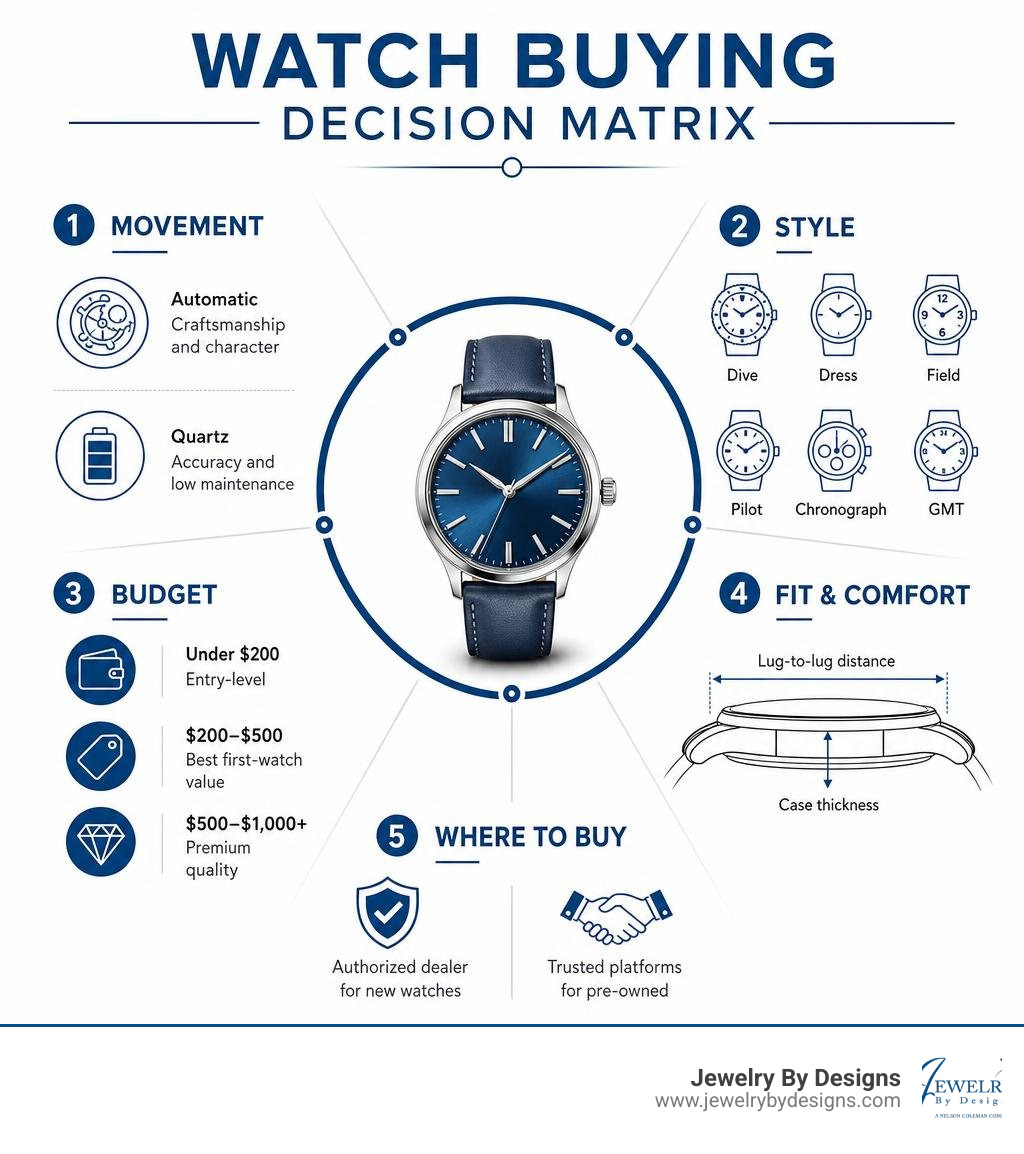
Here’s a quick overview of what to consider before you buy:
| Decision | What to Focus On |
|---|---|
| Movement type | Quartz for accuracy and low maintenance; automatic for craftsmanship and character |
| Watch style | Match to your lifestyle — dive, dress, field, pilot, chronograph, or GMT |
| Budget | Under $200 for entry-level; $200–$500 for best first-watch value; $500–$1,000+ for premium quality |
| Fit and comfort | Lug-to-lug distance and case thickness matter as much as diameter |
| Where to buy | Authorized dealer for new watches; trusted platforms for pre-owned |
Most first-time buyers open a browser, search for a good watch under a certain price, and immediately get lost in brand names and specs they have no framework for evaluating. That’s completely normal.
The truth is, the best watch isn’t the most expensive or the most hyped — it’s the one that fits your life, your wrist, and your budget without compromise.
This guide breaks it all down in plain language, step by step.
At Jewelry By Designs, one of Prince William County’s largest jewelry stores, our certified staff has guided countless customers through the watch buying process with honest, personalized advice. Whether you’re in for a repair, an appraisal, or your very first timepiece, we’re here to help you make a confident, lasting choice.
Watch Movements: The Engine of Your Timepiece
Before you look at dials, straps, or bezel styles, you need to understand what makes a watch tick. The movement, or calibre, is the engine of your timepiece. While there are hybrid innovations, almost everything you encounter in the watch buying journey will fall into three main categories: quartz, automatic, and hand-wound mechanical.
- Quartz Movements: Powered by a small battery, quartz watches use an integrated circuit to pass an electrical current through a tiny synthetic quartz crystal. This crystal vibrates at an incredibly consistent frequency (32,768 times per second), translating to an accuracy of within a few seconds per month. Quartz is highly practical, virtually maintenance-free outside of a battery swap every one to two years, and exceptionally shock-resistant.
- Automatic Movements: These are mechanical movements powered by the natural motion of your wrist. A weighted rotor spins as you move, winding the mainspring. If worn daily, an automatic watch will run indefinitely. It offers a sweeping second hand rather than the distinct tick-tick of a quartz watch, representing centuries of micro-engineering tradition.
- Manual-Wind Mechanical Movements: The purist’s choice. These movements lack a rotor and require you to physically turn the crown to wind the mainspring, typically every 24 to 48 hours. It establishes a daily ritual between the wearer and the machine, though it requires discipline to keep it running.
| Feature | Quartz | Automatic | Manual-Wind Mechanical |
|---|---|---|---|
| Power Source | Battery / Solar Cell | Wrist Movement (Rotor) | Manual Crown Winding |
| Second Hand Motion | Ticking (1 step per second) | Sweeping (Smooth) | Sweeping (Smooth) |
| Accuracy | Extremely High (±15 sec/month) | Moderate (±5 to ±15 sec/day) | Moderate (±5 to ±20 sec/day) |
| Maintenance | Low (Battery change 1-2 years) | Mid (Service every 5-7 years) | Mid (Service every 5-7 years) |
| First-Time Buyer Fit | Best for pure practicality | Best for enthusiast entry | Best for traditional purists |
For a first-time buyer, an automatic movement is often the most rewarding starting point because it offers a genuine mechanical experience without the daily chore of winding. However, if absolute precision and “grab-and-go” convenience are your priorities, a solar-powered quartz watch—such as the Eco-Drive Blue Corso by Citizen—is tough to beat.
Third-Party vs. In-House Movements in Watch Buying
As you dive deeper into watch buying, you will inevitably run into the debate over “in-house” versus “third-party” movements.
Third-party movements are built by specialized manufacturers and sold to multiple watch brands. Names like ETA, Sellita (with their famous SW200 workhorse), Miyota, and Seiko (such as the incredibly robust NH35) dominate this space. These movements are mass-produced to high standards, exceptionally reliable, and can be serviced by almost any competent watchmaker in Northern Virginia for a reasonable price.
In-house or proprietary movements are developed, manufactured, and assembled by the brand itself. Historically, they represent exclusivity, horological prestige, and tailored mechanical innovation. However, they come with a catch: higher upfront costs and significantly higher servicing fees, often requiring you to mail the watch back to the manufacturer for weeks or months.
For beginners, starting with a reliable third-party movement ensures hassle-free ownership. To learn more about selecting your first mechanical watch, check out the How to Buy Your First Watch — Beginner’s Guide – Hewore .
Finding Your Style, Materials, and Perfect Fit
A watch is an extension of your daily wardrobe and lifestyle. To choose the right style, you need to match the watch’s design language to your routine.
- Dive Watches: Historically designed for underwater exploration, dive watches are characterized by high legibility, water resistance of at least 100m–200m, and a rotating timing bezel. They are incredibly versatile and look just as good with a t-shirt as they do with a casual suit.
- Dress Watches: Sleek, minimalist, and designed to slide effortlessly under a shirt cuff. They typically feature slim cases, simple dials, and elegant leather straps, like the Black Leather Mens Corso Watch by Citizen.
- Field Watches: Rugged, utilitarian, and built for durability. Originating in military contexts, they prioritize high-contrast legibility, matte finishes to prevent glare, and tough canvas or leather straps. The Black Dial Garrison Mens Watch by Citizen is a textbook example of this classic aesthetic.
- Pilot Watches: Known for oversized crowns (originally designed for gloved aviators to grip) and highly legible, expansive dials. They often feature specialized flight-scale bezels, such as the stealthy Blackout Nighthawk by Citizen.
- Chronographs: Essentially a stopwatch built into a wrist watch. They feature sub-dials and side pushers, offering a sporty, intricate look perfect for timing daily tasks.
- GMT Watches: Designed for travelers, GMT watches feature an extra hour hand that rotates once every 24 hours, allowing you to track two timezones simultaneously.

Case Dimensions and Wearability
One of the most common mistakes in watch buying is focusing solely on case diameter (e.g., assuming a 40mm watch fits all wrists). To find a watch that wears comfortably all day, you must evaluate three dimensions:
- Lug-to-Lug Distance: This is the measurement from the very top tip of the watch lug to the very bottom tip. If this distance exceeds the flat width of your wrist, the watch will overhang, causing the strap or bracelet to drape awkwardly and feel unstable.
- Case Thickness: A watch that is 15mm thick will wear much heavier and catch on sleeve cuffs far more often than a slim 10mm watch, regardless of diameter.
- Bracelet Integration: How the strap or bracelet attaches to the case affects how it wraps around your wrist. Female end links (which pivot downward immediately) allow a watch to fit smaller wrists much better than male end links (which protrude outward before curving down).
To dive deeper into the mathematics of wrist comfort and case proportions, refer to The Ultimate Watch Buying Guide: How to Choose the Right Watch .
Materials and Finishing Techniques
The materials used in a watch’s construction determine its weight, durability, and how it ages.
- Stainless Steel: The industry standard for a reason. It is durable, corrosion-resistant, and easily refinished.
- Titanium: About 40% lighter than steel and hypoallergenic, titanium is excellent for active wearers. Modern advancements, like the Titanium Zenshin Chrono Mens Watch by Citizen, provide incredible strength without the wrist fatigue of heavier metals.
- Bronze: An enthusiast favorite that oxidizes over time, developing a unique patina based on your skin chemistry and environmental exposure.
- Ceramic: Virtually scratch-proof and lightweight, though it can crack under high-impact drops.
Quality watches are distinguished by their finishing. Look for a mix of brushed surfaces (which hide scratches) and mirror-polished chamfers (beveled edges) that catch the light. Finally, always prioritize sapphire crystal over mineral glass; sapphire is nearly as hard as diamond and will keep your watch face scratch-free for decades.
The Essential Guide to Watch Buying
Your budget is the ultimate guidepost for your search, but it doesn’t have to limit your options. Excellent craftsmanship exists at every single price tier if you know what to look for.

Budget Tiers: What to Expect
- Under $200: This tier is dominated by highly reliable quartz and entry-level automatic movements. You can expect solid stainless steel cases and reliable water resistance. Excellent everyday options like the solar-powered Blue Weekender by Citizen offer fantastic value without requiring a massive financial commitment.
- $200–$500: The sweet spot for a first automatic watch. Here, sapphire crystals become more common, and you’ll find vastly improved bracelet construction with solid end links. Highly capable mechanical divers like the Blue Dial Promaster Diver Automatic Watch by Citizen offer incredible durability and enthusiast-level specs in this range.
- $500–$1,000: This tier introduces Swiss-made movements, superior dial details (such as applied indices instead of printed ones), and specialized materials like titanium or ceramic bezels.
- $1,000+: The entry point into luxury and heritage watchmaking. At this level, you are paying for hand-finished cases, in-house mechanical movements, and historical pedigree.
For a complete perspective on navigating the early stages of watch collecting, read Watch Collecting for Beginners: A 2026 Buyer’s Map — Trillionaire Daily .
Evaluating Quality in Your Watch Buying Journey
When evaluating a watch in person at our Woodbridge showroom, look past the brand logo and test these tactile details:
- Crown Action: Unscrew and pull out the crown. Does it feel sturdy, or does it wobble? Turning the crown should feel smooth and deliberate, not gritty.
- Case Finishing: Run your finger along the edges of the case. The transitions between brushed and polished surfaces should be crisp, but never sharp enough to feel scratchy.
- Bracelet Construction: Shake the bracelet gently. Does it rattle loudly? High-quality bracelets use solid metal links and screw pins rather than folded metal and friction pins, offering a reassuring weight and flexibility.
- Dial Depth and Lume: Look at the dial under a magnifying loupe. Applied indices should be perfectly aligned, and the luminous paint (lume) should be applied evenly across the hands and markers for strong low-light legibility.
Where to Buy: Authorized Dealers vs. Secondary Markets
Where you choose to buy your watch affects your warranty, authenticity guarantees, and overall peace of mind:
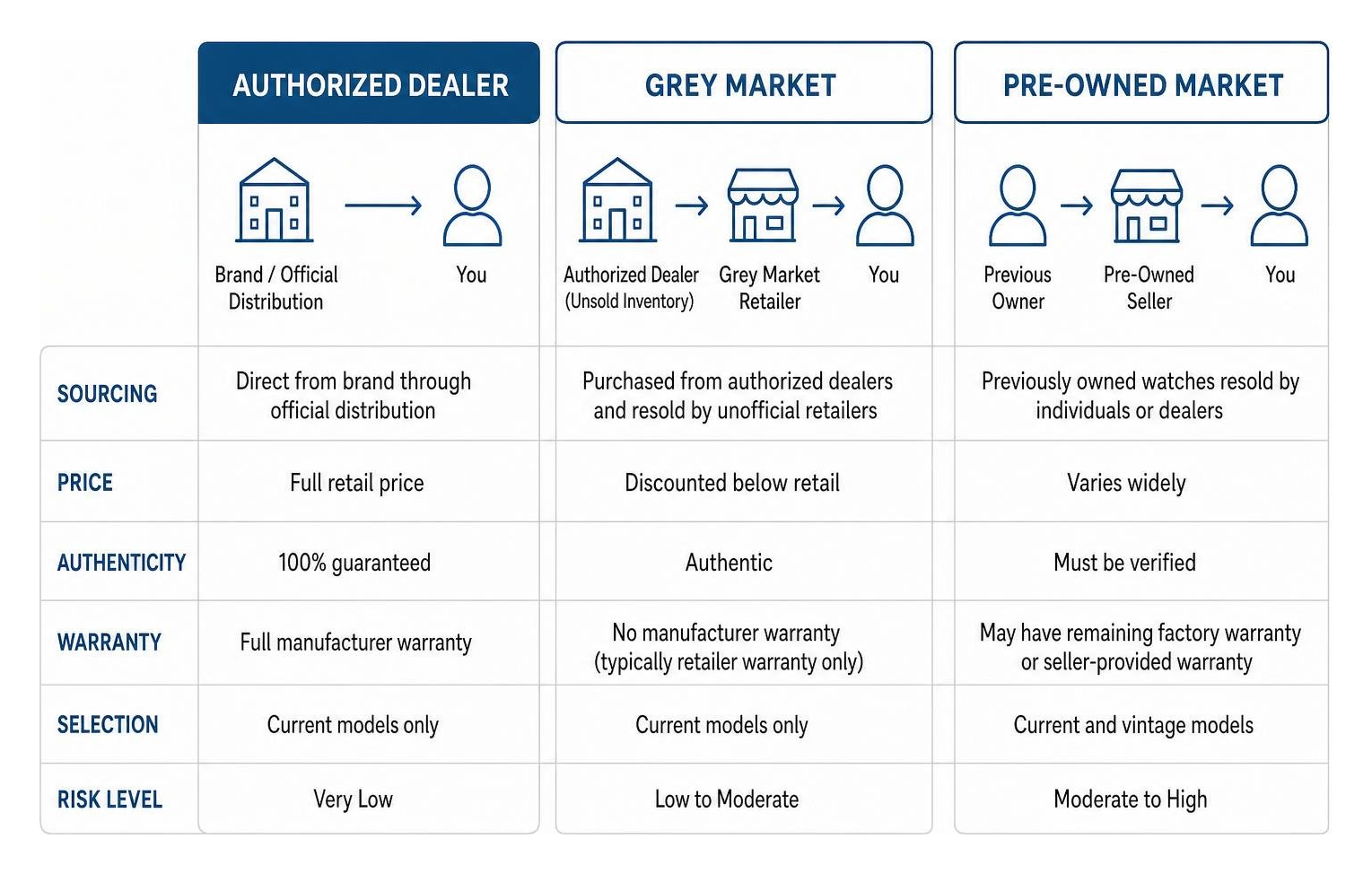
- Authorized Dealers (ADs): Buying from an AD like Jewelry By Designs means you are purchasing directly from the brand’s official distribution network. You get an absolute guarantee of authenticity, a pristine factory warranty, and dedicated local support. For high-end Swiss luxury, visiting an authorized boutique ensures a premium purchasing experience.
- The Grey Market: These are unauthorized retailers who buy unsold inventory from ADs and sell them at a discount. While you can save money, you forfeit the manufacturer’s warranty, replacing it with the retailer’s in-house warranty, which can vary wildly in quality.
- The Pre-Owned and Estate Market: Buying used is a fantastic way to find unique vintage designs and escape initial depreciation. However, it requires vigilance to avoid counterfeit or “Frankenstein” watches (genuine cases with incorrect aftermarket parts). If you are looking to buy or sell pre-owned, working with trusted local experts or exploring authenticated estate options can mitigate these risks.
For a comprehensive look at the logical steps of making a secure purchase, check out Esquire’s guide on How to Buy a Watch .
Frequently Asked Questions About Watch Buying
What is the best watch movement for a first-time buyer?
For most first-time buyers, an automatic mechanical movement is the most satisfying choice because it introduces you to the heritage of watchmaking without requiring daily winding. However, if you want a reliable daily wear watch that you don’t have to reset after a weekend off the wrist, a light-powered quartz movement (like Citizen’s Eco-Drive) offers unmatched precision and convenience.
How do I choose a versatile “one-watch” collection?
To find a single watch that transitions effortlessly from the gym to a board meeting, look for a stainless steel sports watch with a dark dial (black, blue, or slate grey) and at least 100 meters of water resistance. A classic diver like the Eco Drive Promaster Diver Watch by Citizen can easily be dressed up on a steel bracelet or dressed down on a rubber or canvas strap.
How often does a mechanical watch need to be serviced?
Most modern mechanical and automatic watches require a complete professional service every five to seven years. Over time, the internal synthetic lubricants dry out, which can cause friction and wear on the delicate gears. Regular servicing keeps your watch running accurately and preserves its water-resistant seals.
Conclusion
At its core, watch buying is about balancing brand heritage, build quality, and your own personal style. While marketing campaigns emphasize prestige, the most satisfying watches are those that tell a story on your wrist and reliably accompany you through daily life.
At Jewelry By Designs, we have spent nearly 200 years as a family-owned business helping the Northern Virginia community find, maintain, and cherish their jewelry and watches. Our in-house, GIA-trained experts are always ready to help you navigate your next purchase, appraise a family heirloom, or service a beloved timepiece.
Ready to find a watch that fits your story? Explore our curated collection of fine timepieces online, or visit our Woodbridge showroom today to experience these exceptional watches in person.